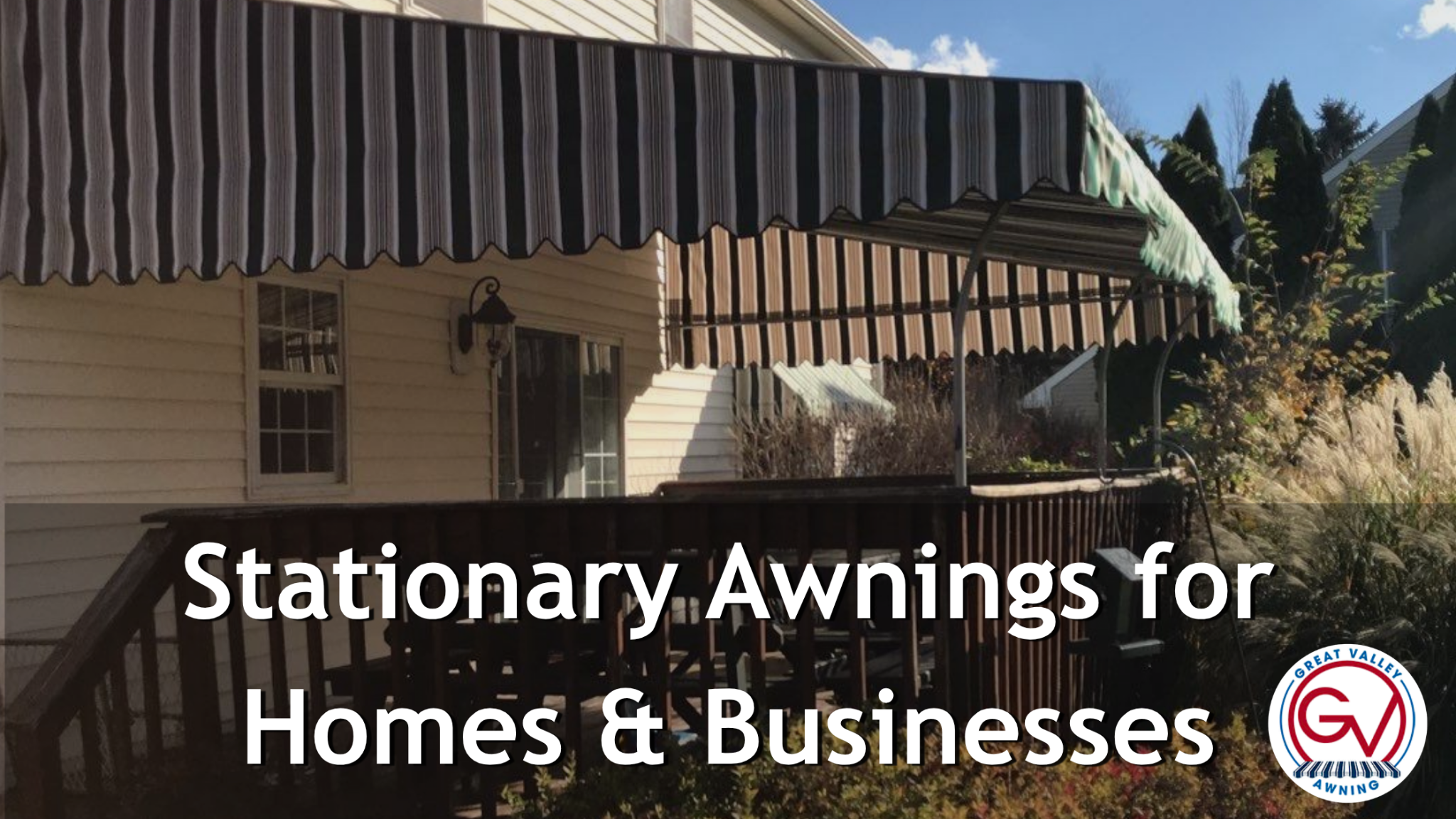
Stationary Awnings for Homes and Businesses: When Fixed Shade Makes More Sense
Stationary Awnings for Homes and Businesses: When a Fixed Shade Makes More Sense
Retractable awnings get most of the attention — and for good reason, since the ability to open and close for shade on demand is genuinely useful for a lot of properties. But retractable isn’t always the right call. For certain spaces, a stationary awning — fixed in place, no motor, no remote — is the more practical choice. The awning experts at Great Valley Pool and Seasonal Outdoor offer both, and knowing which one fits your property starts with understanding what a stationary awning actually does well, where it tends to make the most sense, and how it compares to the other fixed shade options in Great Valley’s lineup.
What Makes an Awning “Stationary”
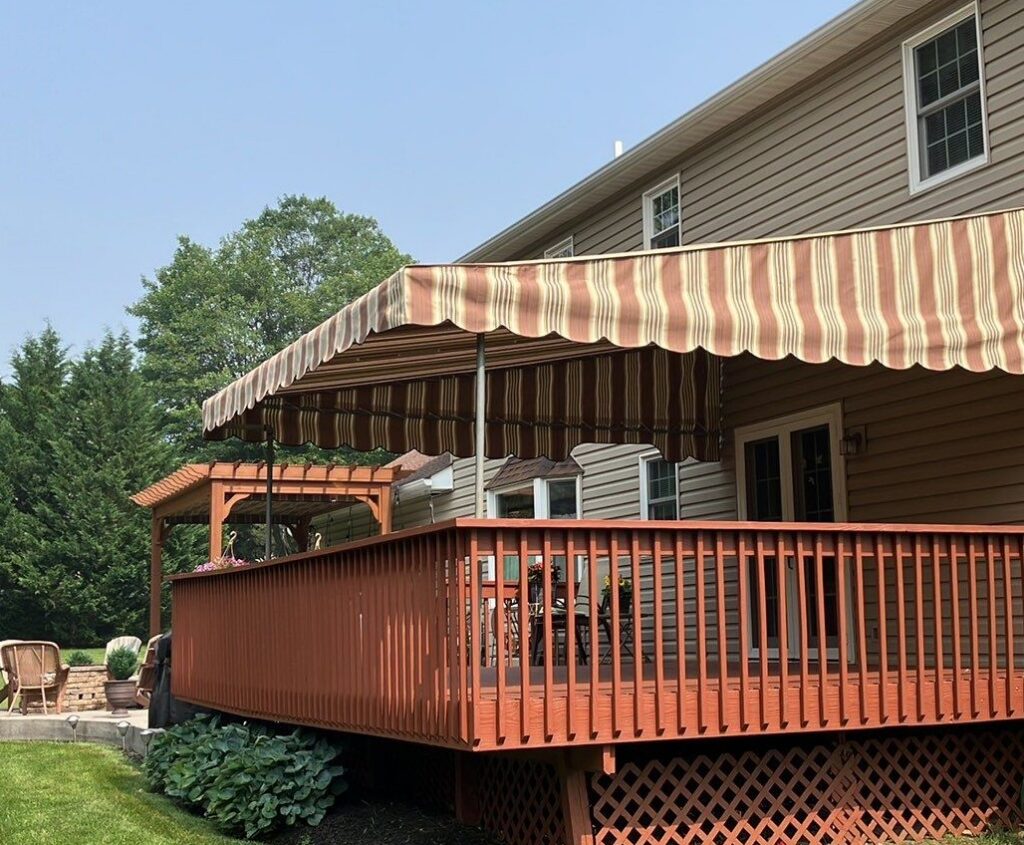
A stationary awning is mounted permanently over a defined space, and the frame stays in that position year ‘round, rather than extending and retracting on demand. There’s no motor to maintain, no remote to program, and no wind sensor deciding when to pull the fabric in. What you get instead is consistent, dependable coverage over exactly the area you need shaded — a patio, deck or balcony, a storefront entrance, a side door or stairwell — without another mechanical system to think about.
That simplicity is the whole appeal. A stationary awning isn’t a scaled-down version of a retractable one; it’s a different tool built for a different kind of space, one where the shade requirement doesn’t change much from morning to evening or season to season.
Why Businesses Often Choose Stationary Awnings
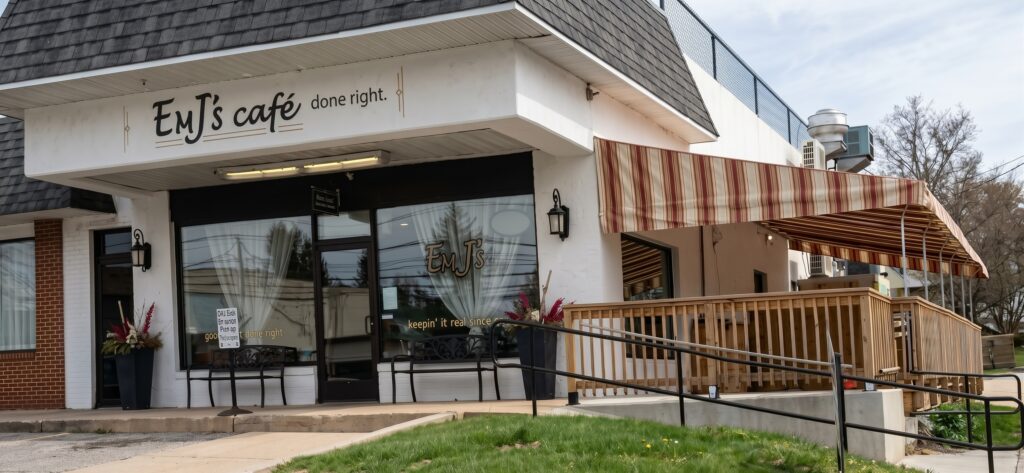
Commercial properties are where stationary awnings are definitely the best choice. A storefront entrance, office door, or shopping center walkway benefits from shade and weather protection that’s simply always there — for customers walking in during a summer downpour or an employee stepping outside on a bright afternoon. Restaurants can certainly benefit from adding a charming, covered, outdoor seating area, not only giving them more available seats, but also adding ambience to their exterior. Great Valley’s Commercial Awnings serve exactly this kind of application across Chester County, Delaware County, and into New Castle County, Delaware: durable, weather-ready structures built to handle regular foot traffic and Pennsylvania weather without needing daily adjustment.
There’s a branding upside too. A well-built awning over a business entrance is a fixed, visible piece of signage every time a customer approaches — something a retractable system, closed half the time, doesn’t offer in the same way. For a retail storefront or restaurant entrance, that consistency can matter as much as the shade itself.
Where You’ll See Stationary Awnings Around Chester County
The applications tend to fall into a few recognizable categories. On the commercial side, storefront overhangs along Main Line business districts, restaurant patio covers, and entrance canopies for medical and professional offices are common — spaces where a business needs the same coverage every day, rain or shine. Shopping center walkways and loading or delivery entrances are another frequent application, where weather protection matters more for practicality than for curb appeal.
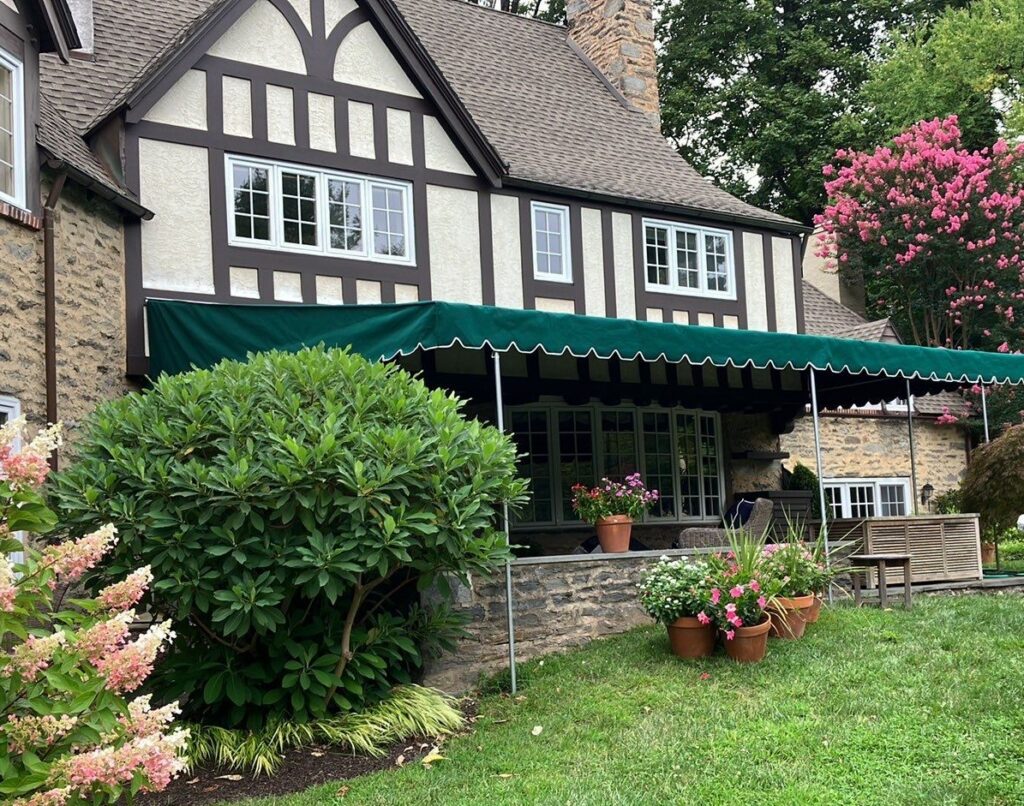
On the residential side, stationary awnings show up over mudroom entries, basement walkout doors, and side entrances that get used daily but don’t need the flexibility of a full patio system. Kitchen or dining room windows with hard afternoon sun exposure are another common spot — a fixed awning over that one window can noticeably cut down on glare and heat gain in a room without adding a motorized system to the house. Homeowners with a small side patio or reading nook with a sunny window often find a stationary structure does everything they need without the added cost and complexity of retraction hardware.
Where Stationary Awnings Make Sense at Home
Residential applications tend to be more targeted than commercial ones. A stationary awning works well over a space that needs the same amount of shade regardless of season or time of day — a side entry door, a stairwell leading to a basement or walkout, or a smaller patio where the homeowner isn’t interested in operating a retractable system. Homeowners with a window that takes direct afternoon sun and heats up a room every summer also look at fixed awnings as a simple, no-maintenance fix, rather than adding a motorized system to manage on top of everything else around the house.
If a space doesn’t need the flexibility of full sun on demand, a fixed awning gets the job done with nothing left to maintain beyond periodic cleaning.
Stationary vs. Retractable: How to Decide
The tradeoff is straightforward. A retractable awning — like The Sunesta or The Sunstyle — gives you control: shade when you want it, full sun and open sky when you don’t, and the ability to retract before a storm or high wind event. A stationary awning trades that flexibility for simplicity. It typically provides three seasons of shade, (It is recommended that you take down the fabric in the fall to prevent damage from winter snow and ice and re-hang in the spring. Commercial applications over storefronts and windows have smaller surface areas and are often kept up throughout the year.) no adjustments are required, and is one less mechanical system on the property.
For most homeowners, the right answer depends on how the space gets used. A patio where the family wants control over sun and shade throughout the day is usually a better fit for a retractable system. An entryway, storefront, or narrow side space that just needs consistent coverage is often better served by something fixed. Some properties end up with both — a retractable awning over the main patio, and a stationary structure over a side door or window that just needs steady coverage.
Not every home can accommodate a retractable awning. In some cases, there isn’t enough wall space for installation. In others, the structure behind the siding isn’t strong enough to support the weight of a retractable awning without significant renovations. Roof-mounted installations also require the right roofline. If the roof slopes toward the sides of the patio or deck, a roof-mounted retractable awning usually isn’t an option. These are just a few situations where a stationary awning provides the ideal solution.
Cost is part of that calculation too. A stationary awning is generally simpler to manufacture and install than a comparably sized retractable system, since there’s no motor, remote, or retraction mechanism to build in. That doesn’t mean stationary is always the cheaper option overall — a large commercial installation can still be a significant project — but for a single window or a side entry, it’s often the more economical way to solve a shade problem that doesn’t call for flexibility in the first place.
Stationary Awnings Compared to Great Valley’s Other Fixed Shade Options
Homeowners sometimes lump every non-retractable shade product together, but Great Valley’s lineup actually includes distinct fixed and semi-fixed options worth telling apart. Porch Enclosure Systems by SummerSpace convert an open porch into a three-season room rather than simply shading it — a bigger project than a stationary awning, and the right call when the goal is a usable enclosed space rather than just shade over a doorway or window. Porch enclosure panels offer many options: screens, windows and doors, and the ability to remove or open them when desired.
A stationary awning sits in a specific niche; smaller in scope and simpler than a porch enclosure Figuring out which of these actually fits a given space is exactly the kind of question worth bringing to a Great Valley consultation rather than guessing from a product page.
Fabric, Frame, and Financing
Great Valley Pool and Seasonal Outdoor brings the same standard of custom-built construction to fixed applications as it does to retractable ones — matching frame colors and fabric options to the property rather than working from a limited catalog. Every project, stationary or retractable, is built to the specific dimensions of the space it’s covering, not assembled from off-the-shelf parts.
Great Valley offers both in-house financing and financing through a trusted home improvement lender. These flexible financing options can make it easier to include a stationary awning as part of a larger exterior improvement project while keeping your budget on track.
What to Expect from the Process
Because a stationary awning has no motor or moving parts, installation is generally more straightforward than a retractable system — the frame is measured and mounted to the specific dimensions of the space, and the fabric is fitted once, rather than calibrated for smooth retraction and extension. That simplicity carries into ongoing upkeep too: periodic fabric cleaning, an occasional check of the mounting hardware and seasonal fabric removal and re-hang is typically all a stationary awning needs to hold up season after season.
Standing Up to Pennsylvania Weather
Because a stationary awning isn’t relying on a motor or a wind sensor to retract before a storm, the frame and mounting hardware need to be built to stay put through everything a Chester County season brings — spring, summer and fall wind and thunderstorms. Great Valley’s stationary installations are engineered with that in mind, using quality frame construction and durable outdoor fabrics..
What to Ask Before You Commit
A few questions are worth working through before settling on a stationary awning. How much daily sun does the space actually get, and at what angle — a quick walk-through at different times of day tells you more than guessing from memory. Is the awning for commercial or residential use? If commercial, do you want graphics on the awning – business name, logo? And for any exterior addition, it’s worth checking with your municipality or HOA, where applicable, on any permitting or architectural guidelines before finalizing a design — Great Valley’s team can talk through the practical side of a project, but local rules vary enough that they’re worth confirming directly rather than assuming.
It’s also worth thinking about the property long-term. A stationary awning installed over a rarely-changing feature — a permanent entryway, a fixed window, a storefront that isn’t being remodeled — tends to be a straightforward, one-time decision. If there’s a chance the space itself will change (an addition, a remodel, a shift in how a commercial space is used), it’s worth flagging that during the consultation so the design accounts for it rather than needing to be redone later.
Talk to Great Valley About What Fits Your Property
Whether you’re weighing a stationary awning for a business entrance or trying to figure out what’s right for a specific corner of your home, Great Valley Pool and Seasonal Outdoor has been engineering shade solutions for homeowners and businesses across Pennsylvania and Delaware since 1998. Get a quote or call or text (610) 889-3104 to talk through what’s right for your space.