
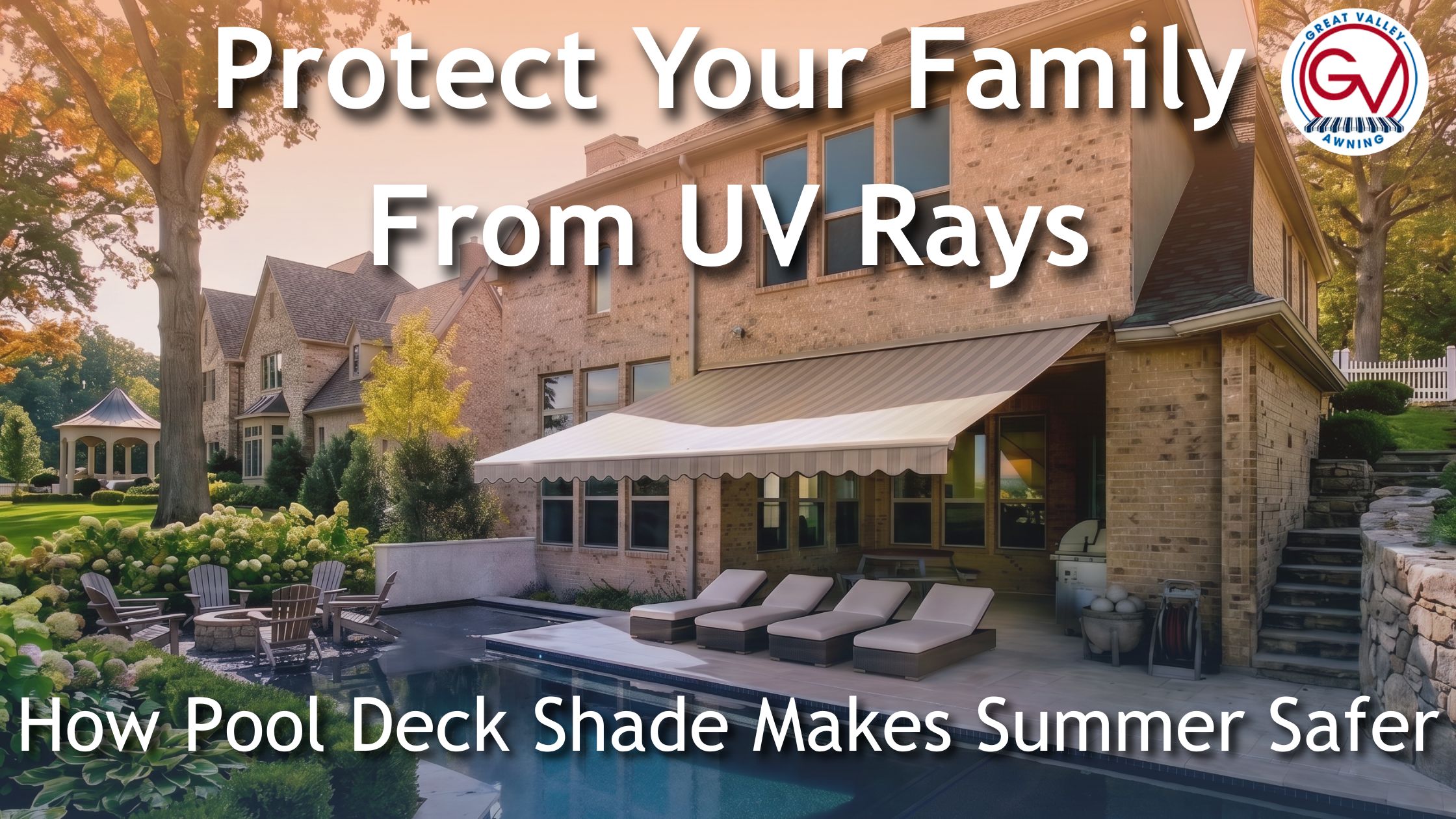
Protect Your Family from UV Rays: How Pool Deck Shade Makes Summer Safer
How Pool Deck Shade Makes Summer Safer
July pool season on the Main Line looks like this: kids in the water from morning until dinner, adults settled on the deck with a cold drink or a book, the whole family making use of everything they spent good money to install and maintain. The pool earns its place in the backyard during these weeks. It’s also the stretch of summer when UV exposure adds up the fastest — and when most families significantly underestimate what they’re dealing with. This is when having a solution for pool deck shade becomes extremely important.
Standard sun-safety advice goes a long way: apply sunscreen, reapply after swimming, watch the clock. But poolside UV exposure operates under conditions that are genuinely different from a walk in the park, and the gap between what most people do and what actually protects a family spending five or six hours by the pool is worth understanding. This piece breaks down why UV exposure at the pool is more intense than it looks, what shade structures do about it, and how summer sun also affects your pool’s water chemistry — with practical steps you can take on both fronts right now.
Why Pool Deck UV Exposure Is Different
Most people think of sun exposure as something that comes from above. Point an umbrella at the sky, block the overhead rays, and you’ve handled it. At the pool, that approach misses a significant part of the picture.
Water reflects ultraviolet radiation back upward. A pool surface in direct July sunlight creates meaningful additional UV exposure for anyone sitting on the deck nearby — coming not just from above but bouncing back from the water in front of them. White or light-colored concrete decking amplifies the effect, reflecting both light and heat from below. For a child sitting at the pool’s edge on a Chester County afternoon, UV is arriving from multiple directions at once: directly from the sky, reflected off the water surface, and radiated back from the deck itself.
A market umbrella helps with the overhead component. It does nothing about the reflected exposure from the water or the radiant heat coming off the deck surface beneath.
Heat runs parallel to UV and accumulates the same way. Dark composite or stone decking can reach temperatures that are uncomfortable to stand on by early afternoon. Families with children often see kids gravitating back into the water to cool off — which means more time in direct sun and less time taking real shade breaks.
Who’s Most at Risk
Children carry the greatest long-term risk from cumulative UV exposure. Sun damage begins early, and the effects are not always visible in real time. A child who spends several summers of July afternoons in unrestricted direct sun on an unshaded pool deck is accumulating UV exposure that will register later — often much later.
Fair-skinned family members burn faster, but skin type doesn’t determine whether UV exposure causes long-term damage. It changes the rate at which visible signs appear. Adults who consider themselves “good tanners” are still accumulating UV with every hour on the deck.
Anyone spending extended time poolside — not just in the water — is at risk. Time on the deck between swims, lunch at a poolside table, watching younger children from a chair in the sun — all of this counts. These are the hours that typically get the least sun-protection attention.
Why Sunscreen Alone Has Limits
Sunscreen is effective when applied correctly and on schedule. In practice, poolside application runs into real-world challenges:
- Children resist stopping to reapply when they’re in the middle of swimming.
- Reapplication timing gets lost in the flow of a long afternoon.
- Common coverage gaps — behind the ears, tops of feet, back of the neck — are easy to miss.
- Water and sweat degrade protection faster than most people expect, even with water-resistant formulas.
None of this is an argument against sunscreen. It’s an argument for pairing it with shade. A family sitting under a properly positioned shade structure receives meaningfully less UV before sunscreen enters the picture. Shade reduces the total UV load from the start. The two work together, and shade makes the sunscreen you apply go further.
How Shade Structures Change the Math
The most practical addition to a pool deck for sun protection is a shade structure positioned over the areas where your family spends the most time out of the water. For most Main Line properties, that’s the patio or deck area adjacent to the pool — where people transition between swimming and resting, where kids congregate after getting out, and where adults settle for the afternoon.
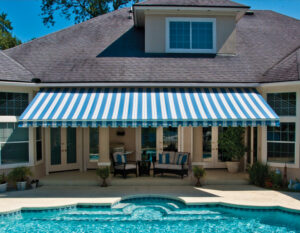
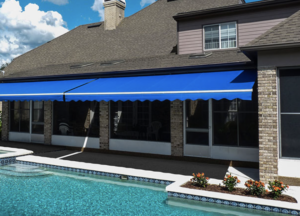
A retractable awning over this zone gives you shade on demand. It extends when the afternoon sun is at its most intense and retracts on overcast days or cool evenings when you want the space fully open. Great Valley Awning carries Sunesta retractable awnings that are custom-built to your deck’s exact measurements, motorized, and available in hundreds of fabric options, with experience fitting pool deck configurations across Chester County and the Main Line communities including Malvern, Paoli, Wayne, Villanova, Bryn Mawr, Ardmore, and the surrounding areas.
For larger pool decks or areas where a wall-mounted awning isn’t practical, shade structures are worth looking at. Retractable Canopies are versatile shading structures that retract manually, with a host of fabric choices, giving your more shade control over the area around your pool. Horizontal shades are another option for overhead coverage across a wider span.
The practical point: shade that deploys and retracts as conditions change is more useful than a fixed umbrella. A motorized awning with a remote means adding coverage when the afternoon sun hits a certain angle — without stopping the afternoon to reconfigure anything. To explore options for your pool deck, visit greatvalleyawning.com or call (610) 889-3104.
How July Sun Affects Your Pool Water Chemistry
UV protection at the pool is not only about your family’s skin. Sun works on your pool water in ways that directly affect how safe and comfortable the pool is to swim in.
Free chlorine — the active sanitizer in your pool — breaks down under UV exposure. On a full July day in Pennsylvania with a pool in direct sunlight, chlorine depletion from UV alone can be significant. Combine that with heavy swimmer use, and the draw on your chlorine level can leave your water under-sanitized faster than you’d expect if you’re only testing once a week.
Cyanuric acid — sometimes called CYA or pool stabilizer — helps protect chlorine from UV degradation. Getting the levels right matters: too low and chlorine burns off quickly in direct sun; too high and the chlorine’s sanitizing effectiveness is reduced. This is one of the more nuanced adjustments in summer water chemistry, and it’s one of the reasons a home test strip often doesn’t tell the full story of what your pool needs in July.
Heat adds to the challenge. Warmer water encourages algae growth and accelerates chemical reactions that consume your sanitizer. A healthy pool sitting comfortably at 70 degrees in June may need more attention to keep chemicals in check at 85 degrees in July.
All of this adds up to one practical conclusion: July is the month when accurate, complete water testing matters most.
Practical Steps for a Safer Summer Pool Deck
A few things worth acting on before the hottest weeks of the season arrive:
Sun angle and shade placement
Peak UV hours run from late morning into mid-afternoon. The west and southwest sides of the pool deck receive the most intense afternoon exposure on most Main Line properties. A shade structure positioned to cover that quadrant — or an awning that extends toward the west — provides the most protection during the hours your family is most active outdoors.
Shaded seating areas
Children who have somewhere shaded to sit between swims take real breaks from sun exposure. A covered table and chairs next to the pool gives them somewhere to go after getting out of the water without retreating inside — which means more breaks, less total UV exposure over the course of a long afternoon.
Regular water testing through summer
Heat, UV, and swimmer use all stress water chemistry simultaneously in July. If your pool hasn’t been tested since early June, mid-July is a good time to come in. Our free water testing takes a few minutes and gives you a complete picture of where your pool stands.
Serving the Main Line Since 1991
Great Valley Pool Service has been taking care of pools throughout Chester County and the Main Line since 1991. From our Frazer showroom on Route 30, we service pools, carry a full selection of chemicals and supplies at shop.greatvalleypool.com, and provide free water testing to anyone who walks in the door.
For pool-related questions or to schedule a service call, call or text us at (610) 889-0711.
For pool deck shade solutions, contact Great Valley Awning or call or text (610) 889-3104.